
Q3 2026: Quarterly Market Review

A review of the third quarter of 2026: an energy shock, rising interest rates, a narrowing equity market and the outlook into the US midterm elections.

The third quarter of 2026 opened with the US economy in the middle of its cycle and recession risk low, but it closed with a very different conversation about interest rates. The ceasefire between the United States and Iran broke down during the summer, pushing Brent crude above $100 a barrel for most of September. With inflation still above target, central banks responded by tightening. More than 80% of developed-market central banks raised rates during the quarter, and the Federal Reserve raised rates in September for the first time in more than three years. Government bond yields rose sharply. By early October, the US 10-year Treasury yield was above 5.3%, its highest since 2002, and the UK 10-year gilt yield was above 5.5%, its highest since 2007.
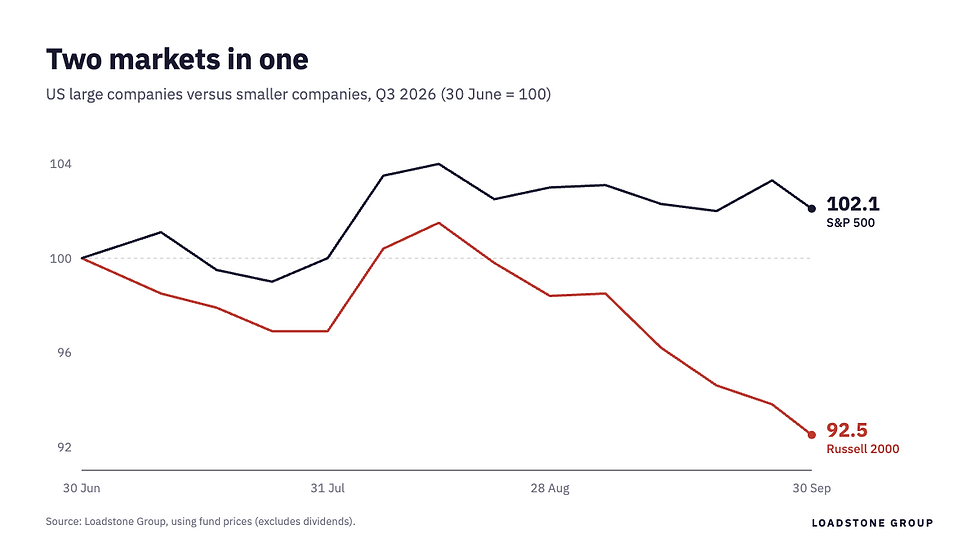
Against that backdrop, the headline equity numbers look calm. The S&P 500 gained 2.3% in the quarter and finished only about 1% below its peak. Underneath, the picture was far less even. Smaller companies fell sharply, bonds lost ground and commodities were the standout performer.
Equities
The Q3 2026 quarterly market review is a story of two markets. The S&P 500 set several record highs and finished the quarter close to its peak. Strong company earnings were the main support, and investment in artificial intelligence infrastructure continued at a pace few expected a year ago. Energy companies led the index as oil prices climbed.
The headline number hides how narrow that strength was. The Russell 2000, which tracks smaller US companies, fell 7.2% in the quarter after gaining more than 20% in the second. Smaller companies tend to borrow more and refinance more often, so rising interest rates hit them hardest. When a handful of very large companies carry an index, the index can look healthy while most stocks do not. We regard this narrowing as the most important feature of the quarter for portfolios.
Outside the US, Japan led developed markets and UK equities held up better than continental Europe, which lagged as energy prices rose and the European Central Bank moved towards higher rates. The FTSE 100 gained 1.1%, its seventh consecutive quarterly rise. Emerging markets ended the quarter slightly lower after a sharp sell-off in semiconductor shares in July.
Fixed Income
Investors came into the quarter expecting interest rates to stay broadly where they were. Instead, higher oil prices and inflation that refused to settle forced a change of course. The Federal Reserve raised rates in September, and markets are now pricing further rises from the major central banks into 2027, although some institutions, including J.P. Morgan, regard that pricing as excessive.
Long-dated government bonds took the brunt of it. US and UK long-term yields reached their highest levels in more than two decades, and the UK 30-year gilt yield moved above 6% for the first time since 1998. The Bank of England held its rate at 3.75% in September, though three of its nine committee members voted for a rise. UK gilts lost 2.5% over the quarter and US Treasuries around 3%. In France, budget worries pushed government bonds down by more than 5%.
Part of the pressure on long-dated bonds comes from supply. Governments are borrowing heavily, and large technology companies have issued more than $200 billion of long-term bonds this year to fund AI data centres.
The positive side for investors is that bond income is now the highest it has been in two decades. Shorter-dated, high-quality bonds offer attractive yields without as much exposure to further swings at the long end.
Currencies and Gold
The US dollar strengthened over the quarter. Higher US interest rates and its role as a safe haven during the Middle East conflict both supported it.
Sterling had a difficult quarter. It reached its quarterly high of around 1.365 against the dollar on 24 August and ended September near 1.32, about 3% lower. Rising gilt yields usually support a currency, but this time they reflected concern about UK government borrowing rather than confidence in the economy. That is why sterling and gilts fell together. The 28 October Budget is now the key test.

Gold rose 3.7% in the quarter but remains around 3.6% lower for the year. Higher interest rates and a firmer dollar raise the cost of holding an asset that pays no income. Central bank buying continues to provide long-term support.
History as a Guide: The Third Quarter, Midterm Years and 2018
Over the long run, the third quarter has been one of the quieter periods for US shares. Since 1950, September has been the weakest month of the year on average, falling slightly more often than it has risen. This year followed that pattern: the S&P 500 dipped modestly in September while smaller companies fell more than 5%.
2026 is also a US midterm election year, with voting on 3 November. Historically, midterm years have been the weakest of the four-year presidential cycle, often marked by policy uncertainty in the run-up to the vote. The period after the election has tended to be much stronger. Since 1950, the US stock market has risen in the final quarter of 16 of the 19 midterm years, by an average of around 7.5%. The year before a presidential election has been positive in every instance over the same period.
The 2018 midterm, during President Trump's first term, is a useful reminder that the pattern is not a promise. The backdrop then was similar to today. The Federal Reserve was raising rates, bond yields were climbing, and trade disputes were weighing on confidence. The S&P 500 reached a record high on 20 September 2018. Then, in the fourth quarter, it fell almost 14% as investors worried that the Fed would tighten too far. The Fed raised rates for a fourth time that year in December, and the index ended 2018 down for the year. The recovery that followed was just as sharp: the S&P 500 returned close to 29% in 2019 once the Fed signalled a pause.
There are important differences today. Interest rates and bond yields are considerably higher than in 2018, while valuations are close to their long-run average after strong earnings growth. History suggests the period after a midterm election has often been rewarding, but 2018 shows that a central bank still raising rates can override seasonal patterns.

What Changed Since the Year-End Outlook
The major institutions have broadly held their constructive view on equities, and several raised their S&P 500 forecasts during the year as earnings exceeded expectations. What has changed is the emphasis. Institutions now consistently prefer quality companies with strong cash flow, are wary of long-dated government bonds, and see AI as an investment theme driven by physical bottlenecks such as power, chips and data centres. BlackRock captured this in its fourth-quarter outlook, which centres on scarcity rather than abundance and upgrades emerging market shares. Opinion is not uniform. PIMCO argues for adding long-dated government bonds as a source of income and protection, and Goldman Sachs remains notably more optimistic on gold than UBS.
None of the major forecasters has cut its year-end equity target, though the quarter has made the path to those numbers less straightforward.
Developing Themes
These are some of the developing themes we are watching beyond the immediate market picture.
AI's physical bottlenecks. The AI build-out is now limited less by software than by power, grid capacity, chips and cooling. Large technology companies are expected to spend around $720 billion on AI infrastructure this year. The companies that supply these scarce resources are increasingly where the earnings are, while the cost of financing this spending is a risk we are watching closely.
Government debt and long-term interest rates. Long-dated bond yields have risen across the US, UK, Europe and Japan at the same time. This reflects heavy government borrowing as much as inflation. If yields keep rising, it raises borrowing costs across the economy and puts pressure on company valuations.
Energy security. The Middle East conflict has shown again how quickly energy prices can move. Even the release of 400 million barrels from G7 strategic reserves did little to hold prices down. Energy, infrastructure and power networks are becoming a long-term investment theme in their own right.
The UK Budget and sterling. The 28 October Budget and the Bank of England's 5 November decision will set the tone for gilts and sterling into year-end. For clients with UK assets or sterling income, this is the most important near-term event.
Emerging markets. Some institutions now see value in emerging markets after strong gains this year. We are watching closely but remain selective, as a strong dollar and rising global yields have historically been difficult conditions for these markets.
Conclusion
The quarter ended with the economy still growing, company earnings strong and recession risk low, but with interest rates higher and the equity market narrower than at any point this year. That combination does not call for retreat, but it does call for care. Quality companies with dependable cash flow, and bonds that pay an attractive income without heavy exposure to long-dated maturities, look better placed than a broad bet on the whole market.
The coming quarter brings three clear tests: the 28 October UK Budget, the 3 November US midterm elections, and further central bank meetings. History favours the period after a midterm vote, but 2018 is a reminder that the direction of interest rates can matter more than the calendar.
If you would like to discuss how the current environment applies to your individual situation, please get in touch.


Comments